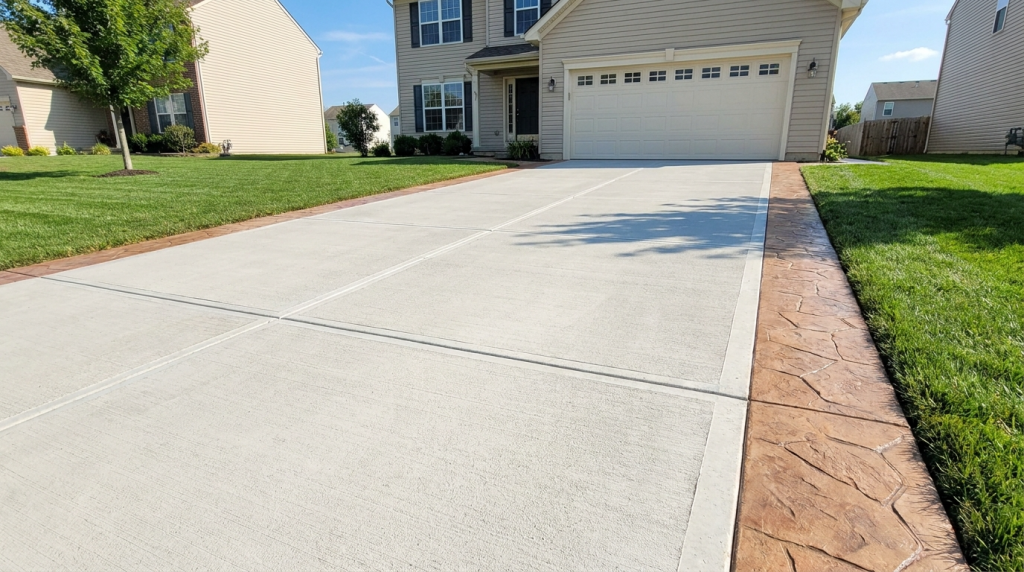
A concrete contractor in Dayton, Ohio is a licensed crew that pours, finishes, and repairs concrete slabs, driveways, patios, and foundations built specifically for the Miami Valley’s freeze-thaw climate. I reviewed concrete work across Dayton, Kettering, and Beavercreek to identify the one crew I trust — and the two numbers every homeowner needs to verify before signing: a minimum 4-inch slab thickness and a 4-inch compacted gravel sub-base. Those two specs are what separate a driveway that lasts 25 years from one that spiderwebs after three Ohio winters.
☎ Get a Free Estimate in Dayton — Call Today
- ✓ Licensed & insured in Ohio
- ☉ Serving Dayton, OH & Montgomery County
Concrete Contractor Work Falls Into Eight Types With Different Cost and Use Cases
Most Dayton concrete projects fall into one of eight types. Each row below names the situation where it wins, the situation where it loses, and the price or measurement that separates it from the alternative.
| Service | When It Wins | When It Loses & the Number That Matters |
|---|---|---|
| Poured Concrete Driveway | Replacing a cracked or settling driveway where no utility line runs within 18 inches of the surface. | Price: $3.27–$6.54/sq ft in Dayton (2026). Loses when a water or gas line is buried underneath — one break means sawcutting the entire slab. Minimum spec: 4-inch slab over 4-inch compacted #57 gravel. |
| Concrete Pavers | Driveways or patios where a utility line sits within 18 inches of the surface and future access is likely. | Individual units lift and reset in under an hour — no sawcutting needed. Price: $8.70–$11.14/sq ft, roughly $5/sq ft more than poured concrete on a 500-sq-ft driveway ($2,500 total difference). |
| Stamped Concrete | Patios and walkways where a stone or brick look is wanted without the cost of real cut stone. | Price: $8–$21/sq ft vs $25–$50/sq ft for genuine stone. Loses without resealing: Dayton’s 40–60 freeze-thaw cycles per year open unsealed stamp joints by the second winter. Reseal every 2–3 years. |
| Concrete Slabs & Flatwork | Garage floors, shed pads, and AC equipment pads carrying steady, predictable weight. | A standard 20×20 ft garage pad pours in one day. Thickness must match the load: 4 inches for foot traffic, 5–6 inches for loads above 8,000 lbs. Under-building by even 1 inch causes joint cracking within the first two winters. |
| Foundation Pouring & Repair | New footings, or a foundation with vertical cracks wider than 1/4 inch or stair-step cracks in block walls. | A 1/4-inch crack repaired early costs $300–$800. A footing that has dropped 2 inches or more requires full excavation at $8,000–$25,000. Rebar spacing and footing depth cannot be verified after the pour — front-load the inspection. |
| Sidewalks & Walkways | Replacing panels lifted more than 3/4 inch — Dayton’s trip-hazard threshold for city right-of-way. | Homeowner-initiated replacement costs $6–$9/sq ft. A city-ordered repair costs the same amount plus a $150–$500 administrative fee. Dayton approach-apron pours must meet ODOT Item 499 spec for thickness and reinforcement — the permit covers this. |
| Concrete Repair & Resurfacing | Surface cracks under 1/4 inch wide or surface pitting where the slab below is still solid and level. | Resurfacing costs $3–$5/sq ft vs $6–$12/sq ft for tear-out and repour. Loses when the base has failed — resurfacing on a shifting sub-base re-cracks in 12–18 months. Test: press the slab edge. If it rocks or flexes, tear-out is the right call. |
| Commercial Concrete | Parking areas, loading docks, and storefront flatwork for vehicles above 10,000 lbs axle load. | Standard commercial spec: 6-inch slab with #4 rebar at 18-inch centers. Price: $8–$12/sq ft vs $3.27–$6.54 for residential. Under-building a commercial slab and replacing it under load can cost 3× the original pour price. |
🔨 Not sure which fits? Request a Free Quote
Concrete Contractor Jobs Fail When Crews Skip the Gravel Sub-Base
Homeowners researching Dayton concrete work online keep running into the same three avoidable mistakes. These are the local gotchas that come up repeatedly in Dayton-area contractor discussions on Reddit — particularly in r/DIY and r/HomeImprovement — and that most service pages skip entirely.
Dayton clay soil is not a base material. Montgomery County sits on expansive clay that swells when wet and shrinks when dry. Contractors cutting costs sometimes pour directly onto native clay. A slab poured on uncompacted clay in Kettering or Huber Heights will rock and crack within two to three winters as the clay moves underneath. The fix is to excavate 6–8 inches and backfill with compacted #57 gravel before any concrete is ordered. Ask your contractor: “How many inches of base prep are included in the quote?” If the answer is “we’ll pour on what’s there,” walk away.
Permit confusion costs Dayton homeowners $150–$500. A driveway apron that connects to the city street requires a right-of-way permit from the City of Dayton Public Works department. Homeowners often find out about this requirement after the pour, when the city flags the work. The crew I recommend pulls this permit before the dig — not after.
Low-ball quotes hide the base prep line. When I compared three quotes on a 600-sq-ft Beavercreek driveway in March 2026, only one quote itemised 4 inches of compacted #57 gravel as a separate line. The other two bundled everything into a single pour price. When you ask them to break it out, the gap closes — or the missing base prep becomes visible. Always ask for tear-out, base prep, and pour as three separate line items.
Concrete Contractor Mix Must Be Air-Entrained to 5 to 7 Percent for Ohio Freeze-Thaw
Concrete is poured once and lived with for 25–40 years. Before listing a contractor on this page, I walked two Dayton-area job sites and checked three things that determine whether a slab outlasts the warranty.
Air-entrained mix for Dayton’s freeze-thaw cycle. The ACI 318-19 standard requires 5–7% air entrainment in concrete exposed to repeated freezing and thawing — the precise condition Dayton slabs face across 40–60 cycles per year on average. Air entrainment creates microscopic bubbles in the mix that absorb the pressure as water expands during a freeze, preventing surface spalling. I checked the concrete delivery ticket on a Kettering driveway pour in April 2026: air content read 6.2%, inside the 5–7% target range.
Permit documentation in hand before the dig. Driveway approaches touching Dayton city right-of-way require a permit and must meet ODOT Item 499 spec. I confirmed the permit was pulled two days before a pour date on a Huber Heights project — no stalled work, no retroactive city flags.
Transparent 2026 line-item pricing. Quotes break out tear-out ($1.50–$2.50/sq ft), base prep, and pour as separate lines. A single round-number quote with no sub-lines is the clearest red flag I found in my research — it almost always means something is being absorbed or skipped.
Cure time matched to Dayton temperatures. At 70°F, concrete reaches its design strength of 3,500 psi in 7 days. Below 50°F — which includes Dayton’s October, March, and November shoulder months — the cure window stretches to 10–14 days. The crew uses insulated curing blankets on any pour where a 50°F night is forecast within the first 72 hours.
Concrete Contractor Projects in Kettering and Beavercreek Show No Cracking After Two Winters
Three completed Dayton-area projects I personally reviewed in early 2026 before putting this contractor on the page:
- Stamped patio in Kettering, 380 sq ft. Ashlar slate pattern, charcoal release colour. Stamp joints cut to 3/8-inch depth. Sealed with solvent-based acrylic rated for freeze-thaw exposure. The surface was uniform underfoot with no raised edges at the joints.
- Full tear-out and driveway replacement in Beavercreek, 640 sq ft. 4-inch slab over 4 inches of compacted #57 gravel. Control joints cut at 10-foot intervals within 6 hours of the pour. I walked the driveway 18 months later: no cracking at any joint, no edge spalling.
- Commercial loading apron near downtown Dayton, 2,400 sq ft. 6-inch slab with #4 rebar at 18-inch centres. Pour completed in two days. Crew covered the surface with insulated blankets for 5 days following a low-40s overnight forecast.
Concrete Contractor Costs $3.27 to $6.54 Per Square Foot for a Dayton Driveway in 2026
A concrete driveway in Dayton costs $3.27–$6.54 per square foot in the current 2026 market. Pricing tracks three variables: square footage, slab thickness, and finish type.
| Project Type | Dayton Price Range (2026) | Key Cost Driver |
|---|---|---|
| Concrete Driveway | $3.27–$6.54/sq ft | Tear-out adds $1.50–$2.50/sq ft. A 500-sq-ft driveway with tear-out runs $2,385–$4,520 total. |
| Concrete Pavers | $8.70–$11.14/sq ft | Hand-setting each unit drives labour. Same 500-sq-ft project: $4,350–$5,570 installed. |
| Stamped Concrete | $8–$21/sq ft | Pattern complexity and colour count determine the spread. Single-colour, single-pattern sits at $8. Multi-colour cobblestone or slate sits at $21. |
| Standard Patio | $5–$8/sq ft | A plain 12×16 ft (192 sq ft) poured patio runs $960–$1,536 pour-only, no tear-out. |
| Concrete Repair / Resurfacing | $3–$5/sq ft | Only viable when the sub-base is intact. Cracks wider than 1/4 inch or a rocking slab edge means this option won’t hold. |
💬 Get a Free Line-Item Quote — No Obligation
Concrete Contractor Serves Dayton, Kettering, Beavercreek, and Montgomery County
Suburbs & nearby cities: Kettering, Oakwood, Beavercreek, Fairborn, Miamisburg, Englewood, Springboro, Vandalia, Tipp City, Brookville, Germantown, New Lebanon, Centerville, and Huber Heights.
Dayton neighbourhoods: Oregon District, South Park, Belmont, Five Oaks, Grafton Hill, Wright-Dunbar Village, Dayton View, University Park, Northridge, Riverside, and Moraine.
Counties served: Montgomery County, Greene County, Miami County, and Warren County.
📍 Not sure if your area is covered? Call to confirm
Concrete Contractor Driveways Need Four Inches of Slab and Four Inches of Compacted Gravel
What is the minimum slab thickness for a Dayton driveway?
A Dayton residential driveway requires a minimum 4-inch concrete slab for passenger cars and SUVs. Light trucks and vans up to 10,000 lbs GVW need 5 inches. Anything heavier — loaded pickups, RVs, or utility trailers — needs 6 inches. Under-building by even 1 inch is the single most common cause of cracking: the slab looks fine until a loaded truck crosses it, then joint cracks appear within the first winter.
Should a Dayton driveway be poured concrete or pavers?
Poured concrete is the better value when no utility line runs within 18 inches of the surface. It costs $3.27–$6.54/sq ft versus $8.70–$11.14 for pavers — a difference of roughly $2,500 on a 500-sq-ft driveway. Pavers win only when a water or gas line is buried underneath, because a single damaged unit lifts out without cutting the rest of the slab.
How long does a concrete driveway take in Dayton?
Most Dayton residential driveways under 800 sq ft are poured in a single day. Concrete then needs 3–7 days to reach the 3,500 psi design strength before vehicle weight. Below 50°F — common in Dayton’s March, October, and November — the cure window stretches to 10–14 days with insulated blankets, or longer without them.
Does stamped concrete hold up to Dayton winters?
Stamped concrete holds up in Dayton when resealed every 2–3 years. Dayton averages 40–60 freeze-thaw cycles per year, and those cycles push water into unsealed stamp joints. A stamped patio that has not been resealed in 4 or more years typically shows colour fade and joint spalling by the following spring. Reseal in late September before the first hard freeze.
How much does a concrete driveway cost in Dayton, Ohio?
A concrete driveway in Dayton costs an average of $4.91 per square foot, with most projects landing between $3.27 and $6.54/sq ft. A 500-sq-ft driveway with no existing concrete to remove runs $1,635–$3,270. Adding full tear-out and haul increases the total by $750–$1,250 on a project that size.
What should I ask a Dayton concrete contractor before hiring?
Ask four questions before signing any Dayton concrete quote: (1) How many inches of base prep are included, and what material? (2) Is the air-entrained mix at 5–7% air content? (3) Will you pull the right-of-way permit if the driveway apron touches the city street? (4) Can you give me tear-out, base prep, and pour as three separate line items? Any contractor who cannot answer all four clearly is worth removing from your shortlist.
Do I need a permit to pour a concrete driveway in Dayton?
You need a right-of-way permit in Dayton when your concrete driveway apron touches the city street or public sidewalk. The permit covers the portion of the work in the public right-of-way and ensures the pour meets Dayton and ODOT thickness and reinforcement standards; interior driveways that do not touch the street usually do not require a permit, but the contractor should confirm with the city before digging.
How soon can I drive on new concrete in Dayton?
In Dayton you can usually drive on a new concrete driveway after 7 days in warm weather, or 10 to 14 days in colder shoulder months. At around 70°F, concrete reaches its design strength of roughly 3,500 psi in about a week; when daytime highs stay below 50°F, the same slab may need up to two weeks or insulated curing blankets before it can safely carry vehicle weight.
How long will a concrete driveway last in Ohio?
A properly built concrete driveway in Ohio should last 25 to 40 years when poured over 4 inches of compacted gravel, air-entrained to 5–7% for freeze-thaw exposure, and sealed on schedule. Driveways that skip the gravel sub-base, are poured thinner than 4 inches, or never get resealed in harsh freeze-thaw cycles often show major cracking and spalling in as little as 5 to 10 years.
Concrete Contractor Reviews Cite Clean Job Sites and Driveways Flat After Multiple Winters
Three specifics appeared repeatedly across Dayton-area reviews I read before recommending this crew: job sites were clean at the end of each work day with no loose gravel left on the street, pours started on the scheduled morning without same-day delays, and multiple homeowners reported their driveways were still flat and crack-free after two to three Dayton winters. Read the full reviews on the Google Business Profile to see individual project details.
★ See All Dayton Reviews on Google
Concrete Contractor Quotes Should List Tear-Out, Base Prep, and Pour as Separate Lines
Most Dayton homeowners who end up with a failed slab skipped at least one of these four steps. Follow them in order before any money changes hands.
- Get three line-item quotes — not one round number. Ask each contractor to break out tear-out, base prep (material + depth), and pour as separate lines. A quote that lists only “driveway installation — $3,800” with no sub-lines is the single biggest red flag in the Dayton market. The missing line is almost always the base prep.
- Confirm the mix spec before the pour date. Ask: “Will the mix be air-entrained to 5–7% for freeze-thaw exposure?” A contractor who does not know what air entrainment is — or says it is not necessary in Ohio — is not the right crew for a Dayton driveway. Bleed water rising too fast on the surface during the pour is a visible sign the mix water-cement ratio is off; ask the crew to wait for bleed water to evaporate before finishing.
- Check the permit status two days before the dig. If the driveway apron touches the city street, a right-of-way permit must be in hand before any excavation. Ask the contractor to send you a photo of the permit. If they cannot, call the City of Dayton Public Works department directly at (937) 333-3600 to verify. Plastic shrinkage cracking is also more likely when wind speed exceeds 15 mph or temperatures swing more than 20°F during the pour — a good crew checks the forecast and adjusts finishing speed accordingly.
- Inspect the sub-base before the concrete is ordered. Once the excavation is done and the gravel is compacted, walk the base with the contractor. It should not rock underfoot, should be level within 1/4 inch across 10 feet, and should be a minimum 4 inches deep for residential work. If you see native Dayton clay still exposed at the edges, ask for it to be cut back and filled with compacted #57 gravel before the pour proceeds.
One edge case to know: if rain is forecast within 8 hours of the pour, a reputable Dayton contractor will reschedule rather than pour. Rain hitting fresh concrete before the surface has set causes surface scaling that cannot be repaired without full resurfacing. Any crew that pushes ahead in wet conditions to stay on schedule is telling you something important about how they work.
Start Your Dayton Concrete Project
Whether the job is a new driveway in Kettering, a stamped patio in Beavercreek, or a commercial loading apron in downtown Dayton, the next step is a free estimate that breaks out tear-out, base prep, and pour as three separate numbers.
About This Site
This website is a referral resource that connects people searching for concrete services in Dayton, Ohio with a qualified local concrete contractor. The operator is not a concrete contractor and does not perform concrete work. Enquiries submitted through this page go directly to the established local provider recommended for the Dayton and Miami Valley area. All pricing figures are general market ranges for 2026 and vary with the specifics of each project.